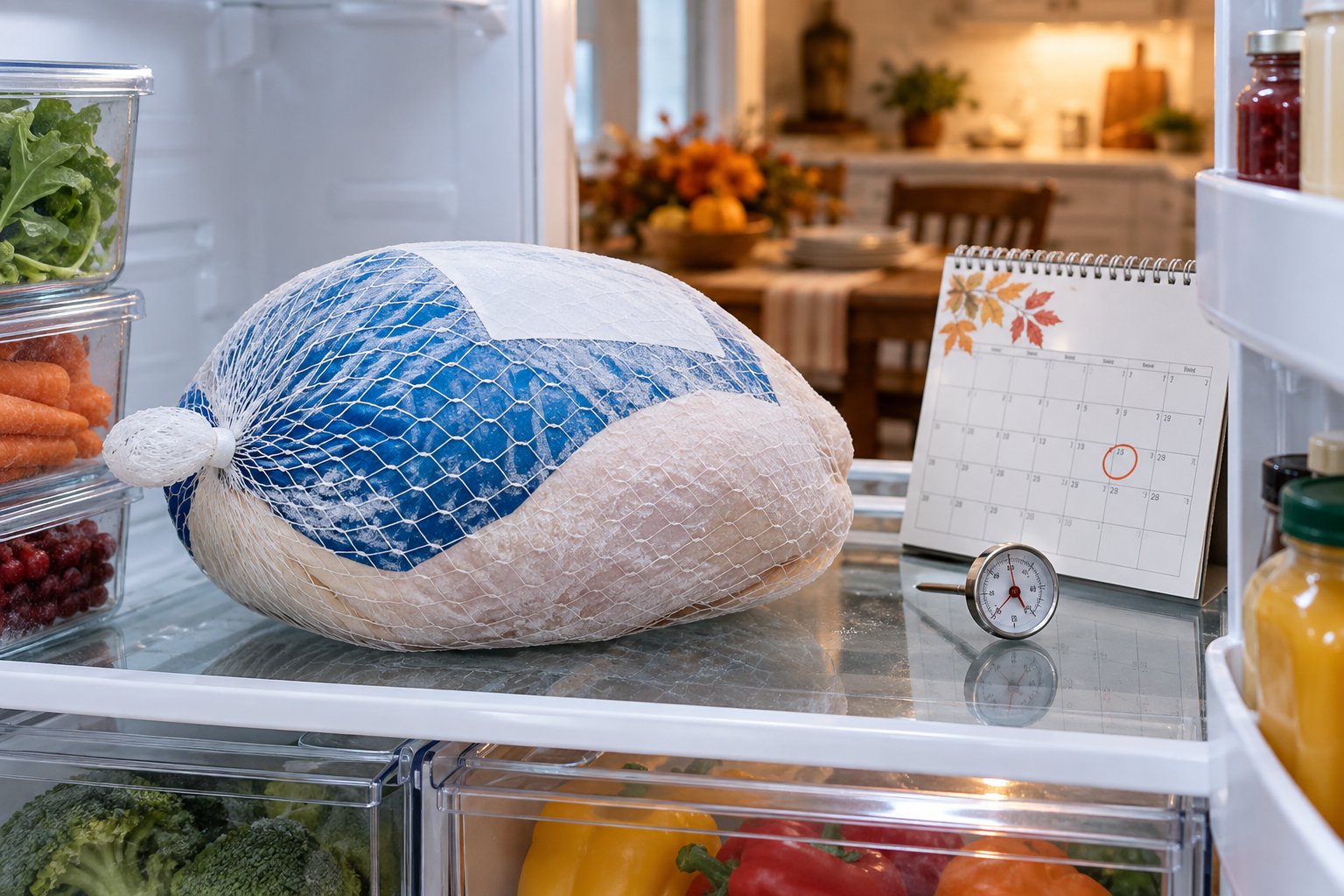
To thaw a turkey safely in the refrigerator, allow about 24 hours for every 4 to 5 pounds at 40°F or below. A 12-to-16-pound turkey needs about 3 to 4 days; a 20-to-24-pound turkey needs 5 to 6 days. Add one extra planning day when possible, because a refrigerator-thawed turkey can remain refrigerated for 1 to 2 days before cooking.
These times come from the U.S. Department of Agriculture's turkey thawing guidance. Check the package and refrigerator temperature before building your plan.
Refrigerator thawing table
Use this USDA schedule for a whole turkey:
- 4 to 12 pounds: 1 to 3 days
- 12 to 16 pounds: 3 to 4 days
- 16 to 20 pounds: 4 to 5 days
- 20 to 24 pounds: 5 to 6 days
Keep the wrapped turkey in a rimmed container on a low refrigerator shelf so juices cannot drip onto other food. Do not thaw it on a counter, porch, in a car, or in another place where temperature is not controlled.
Work backward from dinner day
Write the serving date and planned cooking start. Count backward the full thaw range, then add time for any recipe step that the recipe specifically requires. If you plan to brine, follow a tested recipe and include that time separately.
For a 16-pound turkey served on Thursday, the USDA range is 3 to 4 refrigerator days. Moving it to the refrigerator on Saturday or Sunday provides more margin than starting Monday night.
Do not use a calendar estimate to decide whether the bird is cooked. Thawing and cooking are separate safety checks.
Use cold water only with active attention
USDA allows about 30 minutes per pound for cold-water thawing. Keep the turkey in a leak-proof bag, submerge it in cold tap water, and change the water every 30 minutes. Cook the turkey immediately after it is thawed.
The cold-water ranges are:
- 4 to 12 pounds: 2 to 6 hours
- 12 to 16 pounds: 6 to 8 hours
- 16 to 20 pounds: 8 to 10 hours
- 20 to 24 pounds: 10 to 12 hours
This is a supervised same-day process. It is not a method to start before work and leave unattended.
Microwave thawing is equipment-specific
Many whole turkeys do not fit safely in a household microwave. If yours does, follow the appliance manufacturer's defrost instructions and cook the turkey immediately. Parts of the bird may warm during microwave thawing.
Do not switch to hot water or room-temperature thawing when time runs short. Use one of the USDA methods.
Check cooking temperature in three places
USDA's Thanksgiving food-safety page says cooked turkey must reach at least 165°F. For a whole bird, check the thickest part of the breast, innermost wing, and innermost thigh without touching bone.
Stuffing inside the bird also needs to reach 165°F. Follow a tested recipe and account for the effect stuffing can have on cooking time.
Build the rest of the kitchen timeline
The turkey occupies refrigerator space, a pan, prep surfaces, and often the oven. Before shopping, measure shelf space and verify that the pan fits. List side dishes by cooking temperature and equipment.
Our Thanksgiving prep timeline works backward from serving time, while the guide to hosting your first Thanksgiving helps decide what to borrow, buy, or skip.
Save the final plan where everyone can see it
Write the turkey weight, refrigerator start date, backup method, cooking target, and serving time. Put the note on the refrigerator and add a calendar reminder.
The best Thanksgiving turkey plan is ordinary: enough cold time, a clean container, an accurate thermometer, and no emergency math on Thursday morning.
Did this guide help?
Your optional support helps PeekBlue research and publish practical guides that remain free for everyone.
Support PeekBlue One-time support. Articles stay free.