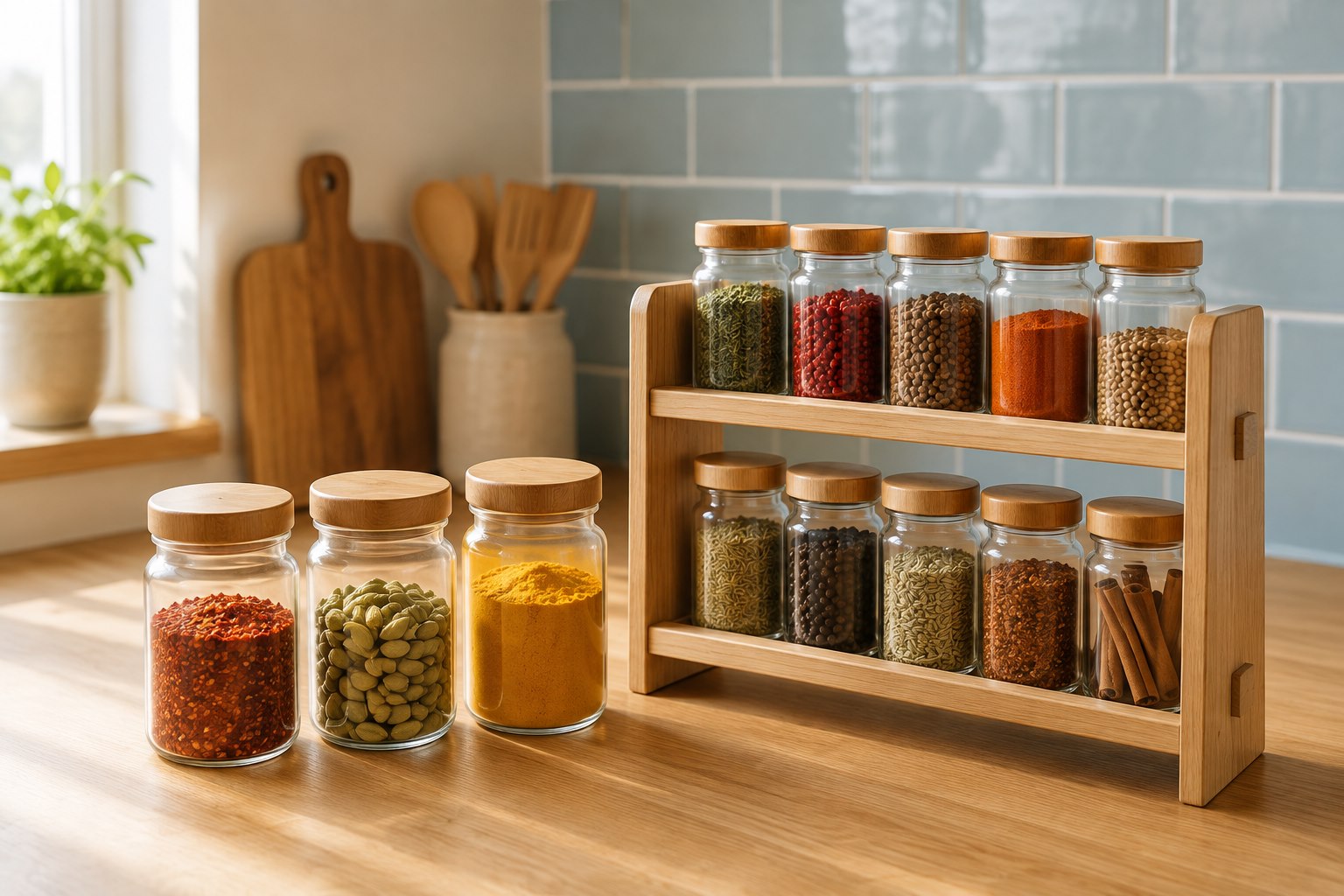
Choose new spice jars if your containers are the problem: poor lids, awkward sizes, or labels you can't read. Choose a rack if the containers work but disappear behind one another. You may need both, although a different arrangement of the bottles you already own is the cheapest place to start.
Jars hold the spices. A rack holds the jars. That distinction matters because a matching set won't create shelf space, and a new rack won't improve an unreliable lid. Identify the inconvenience before shopping for the photograph of an organized kitchen.
What each option actually changes
New jars can make container sizes consistent and give you a labeling system you prefer. They also require transferring spices, washing containers, and finding somewhere for any leftovers that don't fit.
A rack or shelf insert can make existing bottles easier to see and reach. Its usefulness depends on your cupboard measurements and the shapes of your containers. A rack advertised for a certain number of jars may hold fewer of your wider bottles.
Keeping your current bottles avoids a purchase and preserves the original product information. Grouping them in a shallow tray may solve the problem if you only use a modest collection.
This guide compares those arrangements by space, access, and upkeep. It doesn't rank individual products or assume that transferring spices into matching glass automatically improves storage.
Start by emptying one shelf
Gather the spices from the part of the kitchen you're trying to fix. Put duplicates together and separate the seasonings you use often from occasional ingredients. Count what will actually return to that shelf.
For example, a collection of 22 containers might include four duplicates and six items used only for holiday baking. That doesn't necessarily call for a 22-position countertop display. A smaller everyday group plus a labeled backstock box could be easier to manage. The numbers are a planning example, not an ideal collection size.
Look at the remaining containers. If they close properly and fit comfortably in your hand, keep them in contention. Replacing everything because two bottles are inconvenient creates work without necessarily improving the other bottles.
Measure the place where the spices will live
Write down the usable width, depth, and height. Measure inside the cupboard, accounting for hinges and any lip at the front. For a drawer, check clearance with the drawer closed, not just the height of its side panels.
A pull-out rack needs room to move. A door-mounted rack needs to clear the cupboard shelves when the door shuts. A rotating organizer needs clearance for the widest container as it turns. Product dimensions should be checked against all of those movements.
You can mark the proposed footprint with a piece of paper before ordering. On a counter, leave it there while preparing a meal. If it occupies your only chopping space, that attractive storage location has a practical cost you can spot before buying.
Match the labels to your viewing angle
Side labels help when bottles stand on a shelf. Lid labels help when you're looking down into a drawer. A label that works beautifully in a product photo may face away from you in your kitchen.
Readability matters more than matching typography. Check whether the spice name is visible without lifting the container, especially for seasonings with similar colors. Include the original product name for blends whose ingredients differ between brands.
If you transfer spices, preserve relevant ingredient, allergen, and date information from the packaging. A small label on the base or a retained package can help. Don't mix different batches simply to make a jar look full; keeping them distinct makes it easier to track what you have.
Keep storage conditions ahead of display
A rack above the stove is convenient to reach, but heat and steam can make it a poor storage spot. A sunny windowsill has a similar conflict: visibility is good, exposure is less helpful.
McCormick's storage guidance recommends a cool, dry cupboard away from high-moisture areas and advises against shaking spices directly over a steaming pot. It also gives ingredient-specific guidance, so follow the packaging for the product you're storing.
Transparent jars make contents easy to identify, but the jars alone don't protect them from a bright location. Choose the location first. A modest organizer in a suitable cupboard can be a better arrangement than an elaborate display in the wrong place.
Decide how much upkeep you will accept
Decanting brings repeat work. Each refill needs a clean, fully dry container, a way to transfer the contents, and a plan for the amount left in the original package. Check that the jar opening accommodates your measuring spoon as well as a funnel.
Before buying a full set, try one jar with a frequently used spice. Does the lid seal comfortably? Can you wash and dry it according to its instructions? Is the capacity sensible for the package you normally buy?
For a rack, the maintenance question is different. Can you remove it to clean the shelf? Does retrieving a bottle knock over its neighbor? A system that requires taking out half the collection to wipe a spill may be more elaborate than you need.
Which arrangement suits your kitchen?
A shallow drawer: keep sturdy existing jars if they fit; add readable lid labels or a suitable insert. Check that bottles won't roll into the drawer mechanism.
A deep cupboard: consider stepped shelves or a pull-out arrangement to make rear containers accessible. Measure tall bottles on the back tier before buying.
A small, frequently used collection: a shallow removable tray may be enough. You can bring the group to the work area and return it afterward.
Several unsuitable containers: replace those containers individually before committing to an entire matching set. Uniformity is optional; usable closures and clear names aren't.
Try a one-week reset before ordering
For a week, keep your frequent spices together in the proposed location and place occasional ingredients separately. Notice what still bothers you. If you can find and reach everything, the arrangement may already be doing the job.
If the problem persists, buy for that remaining obstacle. New jars solve container problems. A rack solves access problems. Neither needs to become a complete kitchen makeover to be worth having.
Did this guide help?
Your optional support helps PeekBlue research and publish practical guides that remain free for everyone.
Support PeekBlue One-time support. Articles stay free.