
How to Get Your Child Talking About Their School Day
Try specific, low-pressure questions and a calmer time to talk about school. Make room for short answers, stories, and concerns your child wants to share.
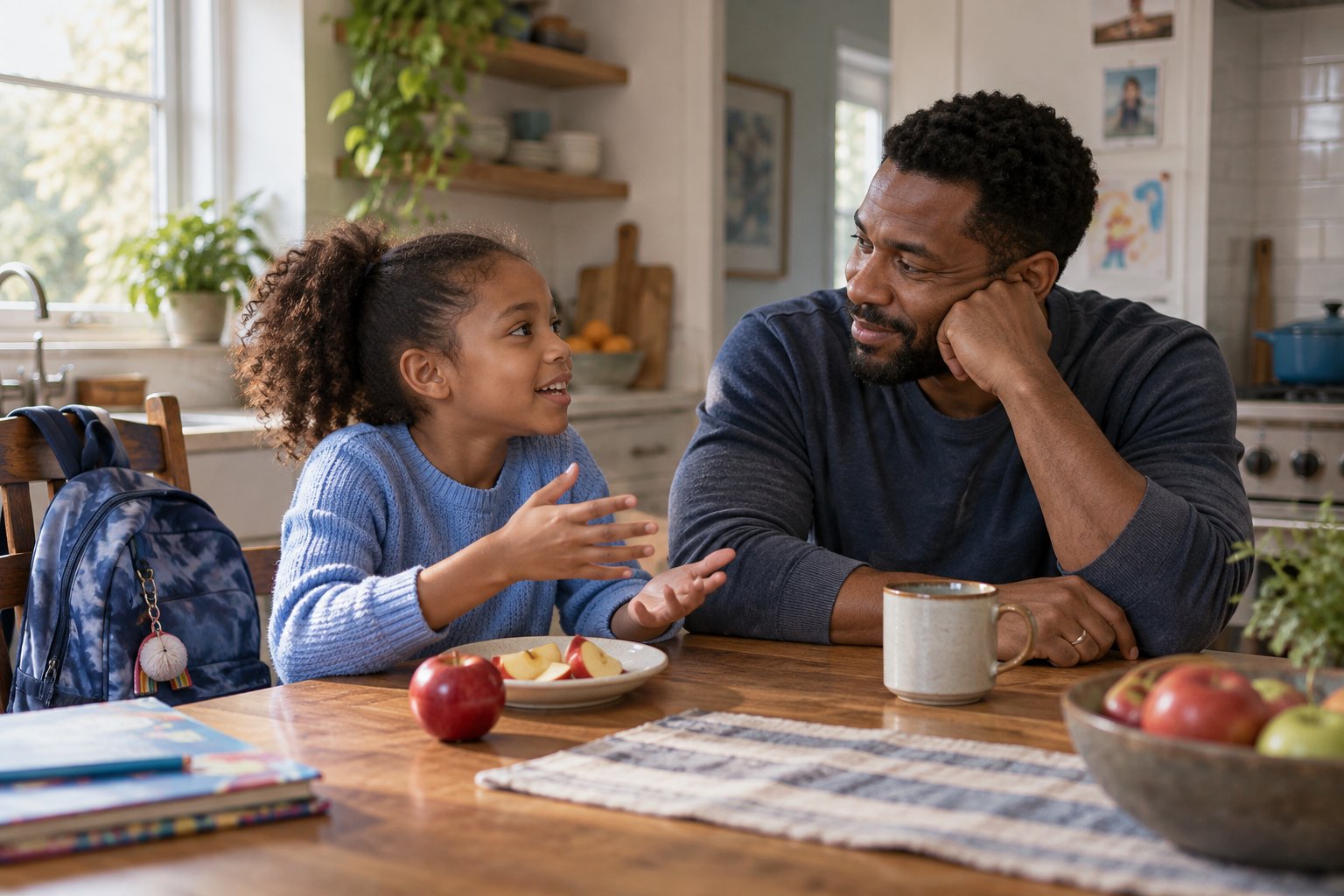
To help your child talk about their school day, choose a comfortable moment, ask about one small part of the day, and leave space for the answer. A conversation during a snack or a shared activity can be easier than a string of questions at pickup. Some days, a short answer is enough.
This guide is for everyday conversations with school-age children. It isn't a way to extract a report or a test of how close your family is. Children differ in how much they enjoy talking, and tiredness can make even an ordinary question feel like another task.
Start with timing, not a better question
At the car door, your child may be thinking about food, a crowded bus, or getting their shoes off. Try a greeting before a question: “I'm glad to see you.” Offer the usual transition home, then see whether conversation comes more easily later.
The American Academy of Pediatrics' guidance on communication at home encourages attentive listening and regular opportunities to connect. You can make that opportunity predictable without requiring your child to perform a daily conversation.
For example, unpack lunch containers together. If a story starts, pause your own task when practical. If nothing comes, you have still spent a few ordinary minutes together. Our after-school routine guide can help make room for that transition.
Ask about something small enough to remember
“How was school?” asks a child to summarize hours of experiences. Try one specific invitation instead. These are example prompts, not a checklist to work through:
- What did you work on with someone else today?
- Was there something funny you wanted to tell me?
- What would you like to show me from your backpack?
- Was any part of the day confusing?
Follow the answer rather than moving to the next prepared question. If your child mentions a model they built, ask what it was supposed to do. You don't need to turn the story into an assessment of their grade or how everyone else performed.
Share a little of your day, too
Try a brief, age-appropriate story: “I couldn't find my keys this morning, and they were in my jacket.” It gives the conversation a two-way rhythm. Avoid unloading adult worries or making your child responsible for comforting you.
You could invite them to draw something, point to an item, or tell you while you walk. Spoken answers aren't the only useful form of communication. Adjust to your child's communication needs and the supports they already use.
When the answer is “nothing”
You can respond, “Okay. If you think of something later, I'd like to hear it.” Then mean it. Repeating the same question in several forms can feel like you don't accept the answer.
A short reply alone doesn't tell you that something is wrong. Pay attention to the wider picture and to changes you observe. If you have a specific concern, ask about it plainly and gently rather than disguising an investigation as casual chat.
When a difficult story appears
Let your child finish before offering solutions. Reflect the part you understood: “You wanted to join the game, and you weren't sure how.” Then ask whether they want help thinking about tomorrow.
If they describe bullying, threats, or harm, take the concern seriously. Write down relevant details and contact the appropriate school adult. The CDC's conversation guidance for caregivers offers further ways to make listening and support part of everyday family life.
Finish with connection rather than a lesson every time. “Thanks for telling me” can be enough. As children get older, the same habit of making room for their perspective remains useful; our guide to listening to a teenager explores that next stage.
Cover: AI-generated editorial illustration.