
Is Costco Worth It for One or Two People? A Simple Break-Even Guide
Calculate whether a Costco membership fits a small household using realistic savings, the annual fee, storage space, and shopping habits.
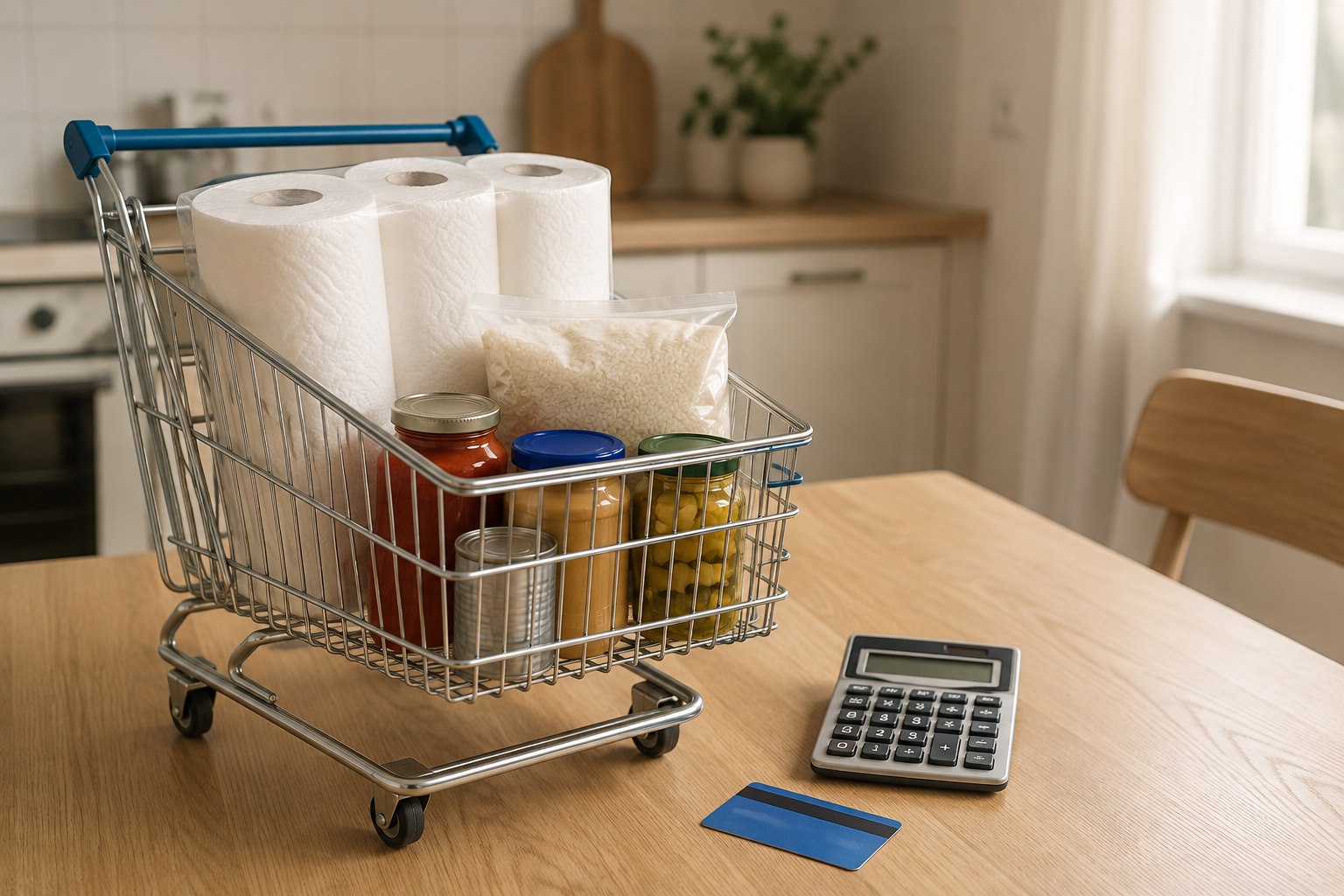
A Costco membership can pay off for a small household if you repeatedly save on things you already buy, have somewhere to store them, and can reach the warehouse without an expensive detour. Start with a normal month's purchases. A cart full of attractive deals tells you much less than the cost of your usual groceries.
For one or two people, the best test is a short comparison basket and an annual savings calculation. Leave potential purchases out of the calculation until you know you'll use them.
Start with the membership fee
Costco's U.S. membership information lists Gold Star at $65 annually and Executive at $130, plus applicable tax. Executive includes a 2% reward on qualifying purchases, with exclusions and a cap. Check the current membership terms before joining; prices and benefits can change.
Use the basic membership fee as the first hurdle. At $65 a year, you need about $5.42 in net monthly savings just to cover membership. That isn't difficult for every household, but it isn't automatic either.
If a warehouse trip makes you buy an extra $15 item every month, the membership calculation has changed by $180 a year. Keep those extras visible instead of treating them as unrelated spending.
Build a basket you would actually buy
Choose eight to twelve repeat purchases from recent receipts. Good candidates are products with predictable use: your usual coffee, a familiar detergent, toilet paper, frozen food you already eat, or a staple you can store comfortably. Use equivalent sizes and quality levels.
Write down four details for each:
- Your current store's normal price and package quantity.
- Costco's price and package quantity for a comparable item.
- How much you realistically use in a month.
- Any part likely to expire, go stale, or remain unused.
Calculate price per ounce, pound, load, or count. Be careful with detergent: compare the stated number of loads and the amount you actually dispense. A larger bottle isn't enough information.
Don't compare a warehouse's premium brand with the cheapest store brand unless you would willingly make that upgrade. Otherwise you're measuring a change in product preference alongside a change in price.
Use net savings, not the receipt's discount total
Try this formula:
Annual net savings = savings on planned purchases + other savings you genuinely use − membership − extra travel − waste − unplanned spending.
Here is an illustrative example, not a price survey. Suppose a couple saves $18 a month on their comparison basket: $216 annually. Membership costs $65. Additional travel costs $36 over the year, and unused food accounts for $30. That leaves $85 before any impulse purchases.
Now suppose the same couple adds $10 of unplanned purchases to each monthly trip. Their $120 of extra spending wipes out the calculated advantage. The items may still be enjoyable, but enjoyment and savings belong on different lines.
For a single person saving $9 monthly, the starting benefit is $108. That leaves $43 after a $65 membership, before travel or waste. A warehouse next to work may make that practical. A special cross-town journey might not.
Check whether the package fits your home
Walk through the storage problem before buying. A large pack of paper towels needs dry space. Frozen portions need actual freezer room, including space for the food already there. An open bag of snacks may not stay appealing long enough for one person to finish it.
Splitting a purchase with someone can help, but only when the arrangement is real. Agree on who pays, how the goods will be divided, and when the other person will collect them. Follow the retailer's membership and shopping rules; don't assume a plan permits card sharing.
Avoid buying a freezer purely to make bulk purchases work until you've included its purchase price, space requirements, and running cost. A storage solution can cost more than the saving it enables.
When does Executive make sense?
If the upgrade costs $65 and the qualifying reward rate is 2%, the simple upgrade break-even is $65 ÷ 0.02 = $3,250 in eligible annual spending. That's roughly $271 a month. This calculation compares Executive with the basic tier; it doesn't prove that Costco beats other stores.
Use qualifying purchases, not your entire household budget. Read the current exclusions, reward timing, and redemption terms. Don't add hypothetical travel bookings or future appliance purchases merely to make the upgrade look worthwhile.
If your normal eligible spending falls well below that threshold, begin with the basic comparison. An upgrade should follow spending you already expect, rather than encourage extra shopping.
What about gas and occasional big purchases?
Include fuel savings only when the station suits routes you actually drive. Multiply the price difference by the gallons you would buy there, then consider the additional distance and time. A cheaper posted price isn't useful if collecting it takes a separate long trip.
An occasional large purchase can cover membership in one year. Compare the exact model, delivery, installation, returns, and any required accessories. Keep that one-off saving separate from the following year's decision, when the same purchase probably won't happen again.
Make a one-year decision, then review it
Join when a conservative calculation shows a worthwhile margin and your storage plan works. Skip or postpone when the result depends on buying more, changing your habits, or wasting less than you realistically will.
After three normal shopping trips, compare total spending and used quantities with your estimate. Keep a note for renewal time. Membership is a recurring purchase, so it deserves the same review as any other subscription.
For more on the storage side of this decision, start with your existing kitchen layout and our guide to spice jars versus a spice rack. Small storage limits often explain why a theoretically cheap purchase feels inconvenient at home.