
7 Things to Check Before Buying Household Supplies in Bulk
Check unit prices, storage, product fit, shelf life, and household use before buying supplies in bulk. Save money without filling every shelf.
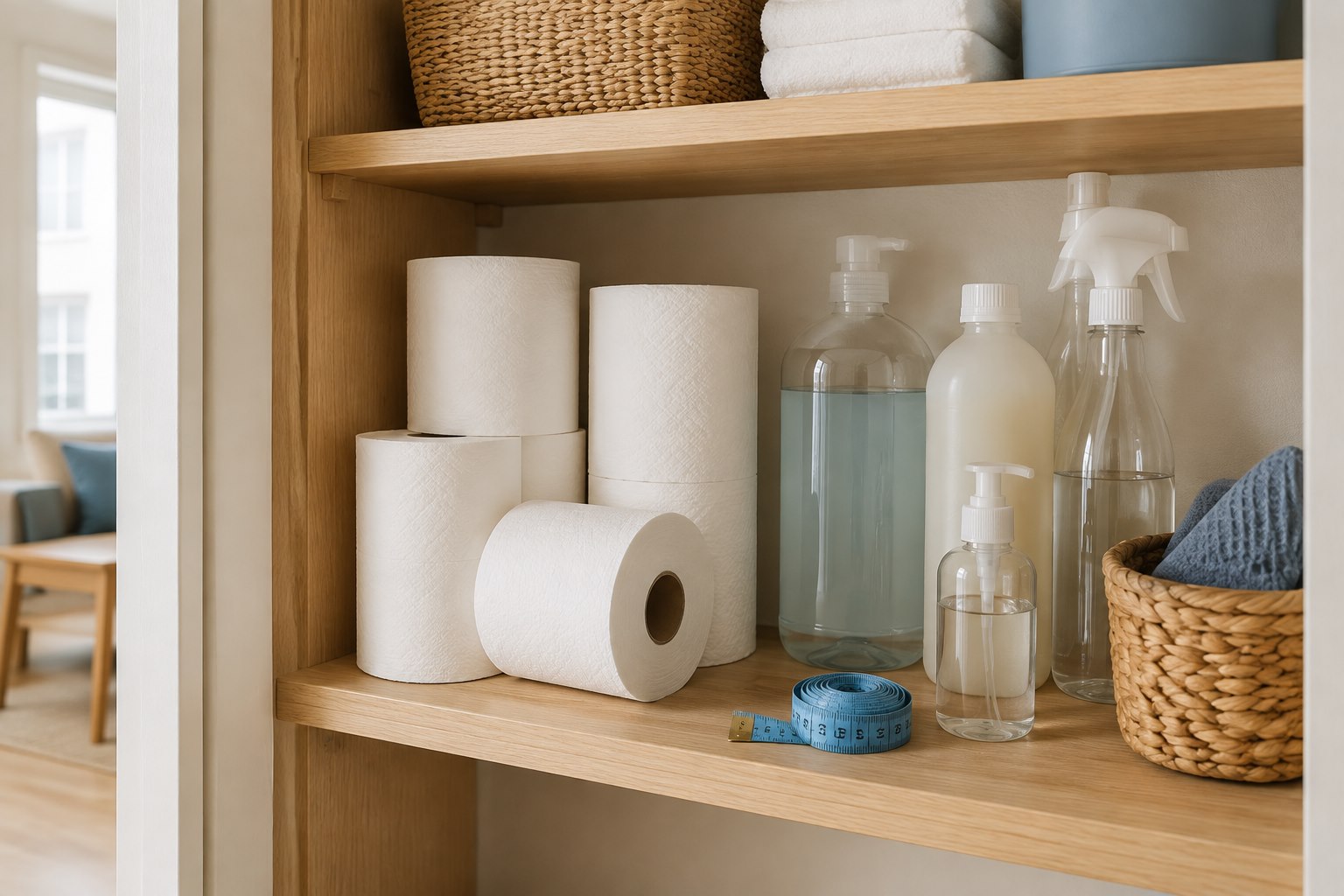
Buy household supplies in bulk when the unit price is lower, the product already works for you, and you can store and use the whole package without creating another problem. A large pack is a commitment of cash and space. Check those limits before treating its size as evidence of value.
This guide covers ordinary household staples such as paper goods, laundry products, and pantry items. The seven checks below help you compare a bulk package with the smaller version you would otherwise buy.
The seven checks at a glance
- Compare the price per usable unit.
- Count how quickly your household uses it.
- Measure the storage space.
- Check whether you already like the product.
- Read storage and shelf-life information.
- Include cash flow and transport.
- Decide how you'll track and replenish it.
1. Is the usable unit actually cheaper?
Divide the total price by a meaningful quantity: ounces, square feet, tablets, or loads. Compare like with like. Paper towel roll counts can be confusing because sheet size and sheets per roll differ. A “mega” label isn't a standard unit.
Use the price you can really obtain today. If the smaller package has a discount that applies to your purchase, include it. If the bulk price requires joining a paid program, allocate some of that cost or assess membership separately.
For an illustrative example, a $24 package used for 120 loads costs 20 cents a load. A $9 package used for 50 loads costs 18 cents a load. The larger container costs more per stated load in this example, despite appearing more economical on the shelf.
2. How long will it take to use?
Check an old receipt or note when you open a package. If one bottle lasts four months, a pack of six represents roughly two years of supply at your current rate. Ask whether you'll still want the same product, live in the same space, or have the same household needs then.
A predictable item is easier to buy in quantity than one tied to a passing activity. A household that does laundry every week can estimate detergent use. A new hobby or an unfamiliar recipe is a weaker basis for a year's worth of supplies.
Keep the estimate conservative. Guests, a one-off cleaning project, or holiday hosting can temporarily raise consumption without changing your usual pattern.
3. Where will the unopened package live?
Measure the whole package, including its height and the space needed to lift it out. Under-bed storage may suit dry paper goods; a narrow cupboard might not accept a heavy jug even if its capacity looks sufficient.
Preserve access to things you use daily. Saving a few dollars is less appealing when every cooking session requires moving a box of supplies. Leave ventilation and equipment clearances intact, and keep exits and walkways open.
Don't buy storage furniture before calculating the effect on savings. If a $40 organizer enables a purchase that saves $8, you've paid for five rounds of that saving up front. Existing shelf space is usually a better starting point.
For kitchen quantities, our spice-storage comparison shows why a container and an organizer solve different problems.
4. Have you used the exact product before?
Try a normal-size package before committing to an unfamiliar fragrance, texture, or formula. A good price can't compensate for a product you stop using after a week.
Check the exact variant even when the brand is familiar. Scent, concentration, sheet size, dispenser fit, and compatibility can change between versions. Keep packaging or a photo of the version you know works.
Avoid splitting a large purchase with friends unless everyone agrees on the product and collection plan. Otherwise your “shared” supply may become a stack of unpaid packages waiting in the hallway.
5. Can it be stored safely for that long?
Read the manufacturer's storage instructions. Keep cleaning products in their original labeled containers, away from children and pets, and avoid transferring them into food or drink containers. Don't mix products to save space.
Food needs a separate calculation. The FDA's food-waste guidance specifically cautions against impulse bulk purchases of perishables. Consider fridge and freezer capacity, how you'll portion food, and whether you'll actually eat it.
The cheapest ounce is the one you use. If a large package costs $12 but you discard a quarter, you haven't received the full quantity you paid for. Compare the cost of the usable portion with a smaller purchase.
6. Does paying now suit your budget?
A genuine unit-price saving can still be a poor purchase this week. Money tied up in supplies isn't available for rent, groceries, or an unexpected expense. Set a bulk-buying allowance after essential spending, rather than treating every discount as urgent.
Include transport. Can you carry the package upstairs? Does it fit in your car or on public transit? A delivery fee or an extra journey may remove the saving. Heavy containers can also be awkward to lift and pour repeatedly.
If the package needs a dispenser, scoop, or additional container, count that cost. A slightly more expensive smaller package may be easier to use without extra equipment.
7. How will you avoid buying it twice?
Give reserve supplies one visible location and use the oldest appropriate stock first. A simple note on your shopping list can say “two unopened bottles remain.” You don't need a special inventory app for six household products.
Set a reorder point based on how quickly you use the product and how easily you can replace it. Buying again whenever there's a promotion defeats the purpose if the previous supply is still untouched.
After the first bulk purchase, check actual use against your estimate. Keep buying that size only if the saving survives waste, storage, and effort. A mixed approach is sensible: bulk for a few reliable staples, small packs for everything uncertain.