
How to Price Handmade Products Without Forgetting Your Time
Build a handmade product price from materials, labor, overhead, packaging, and fees. Use a worked example to separate pay for your time from profit.
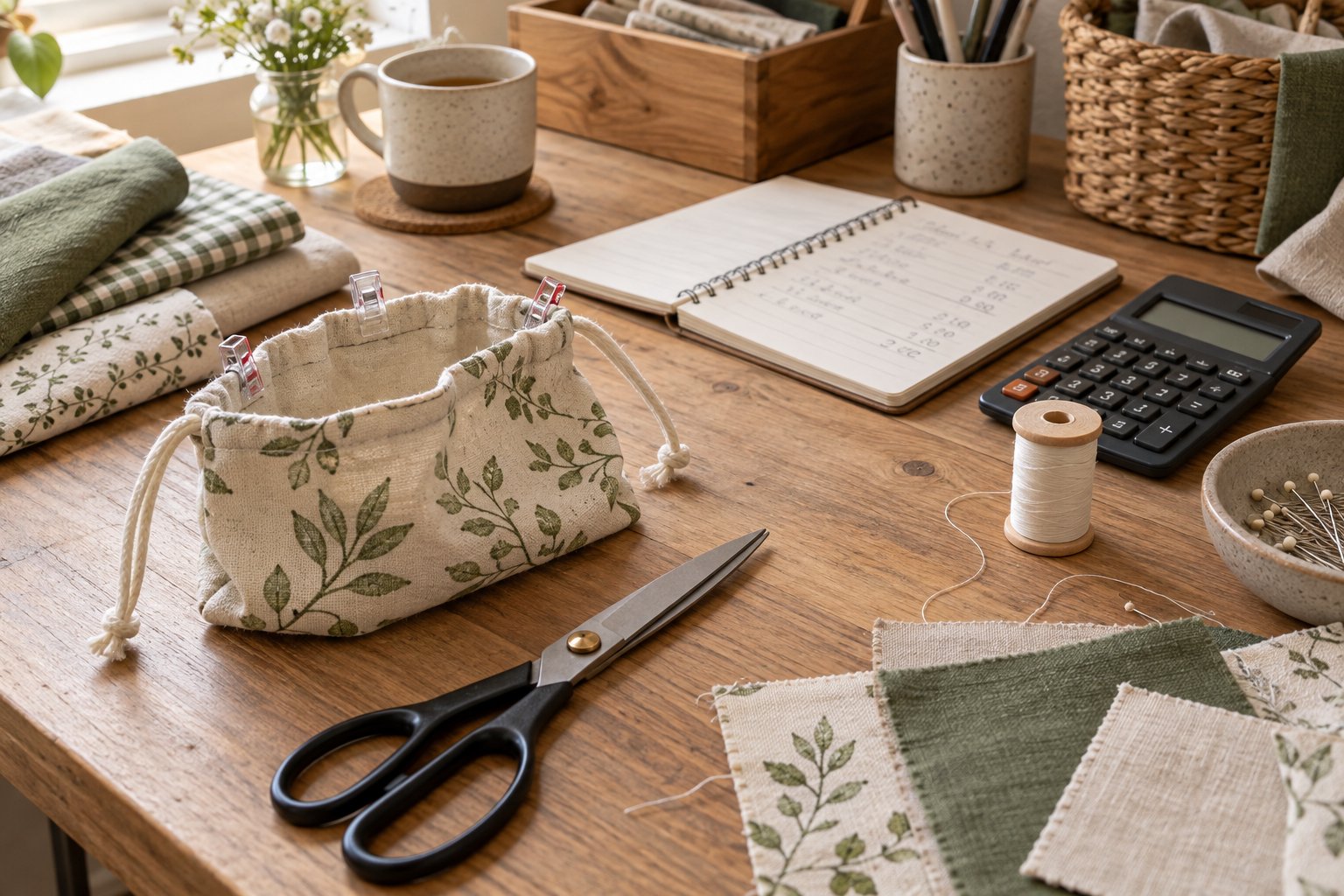
To price a handmade product, add the materials, making time, packaging, and a reasonable share of business costs. Then account for selling fees and the profit you want the sale to leave. Compare that result with the market before deciding what to make, change, or stop offering.
The money left after buying materials is not all profit. It still has to pay for your work and the costs that don't appear inside the finished item. Keeping those amounts separate helps you see whether a busy shop is actually supporting you.
1. Measure the materials you really use
List the components consumed by one saleable item, including small parts, finishes, and a realistic allowance for waste. If a $12 length of fabric produces four usable pouches, the fabric cost is $3 each, before lining, thread, and fasteners. That is a hypothetical example.
Use your actual yield rather than the maximum you might achieve on a perfect day. Track damaged materials and failed pieces over a batch. Spread ordinary production waste over the items you can sell instead of pretending it never happens.
Keep a separate note of supplier prices so you can update the calculation when your next order costs more.
2. Record the work around the making
Time a normal batch from preparation through finishing and packing. Include setup and cleanup, then divide shared tasks across the batch. Separate active labor from unattended drying or curing time, while still recognizing that drying space and equipment have a cost.
Choose an hourly pay target for your own labor. This article's example uses $20 per hour solely to demonstrate the arithmetic; it is not a wage recommendation. An item requiring 45 minutes would contain $15 of labor at that rate.
For custom work, include design conversations and approvals. A five-minute change requested several times may consume more time than the final alteration. Our custom-order checklist helps define what the quoted price includes.
3. Allocate overhead without hiding it
Business costs may include workspace, equipment upkeep, software, and photography supplies. Choose a consistent way to allocate them, using a realistic sales or production volume. Allocating a month's costs over hundreds of items you probably won't sell makes each item look artificially cheap.
Etsy's pricing guide emphasizes looking beyond direct costs. Use your own records to decide which expenses belong to a product, an order, or the business as a whole.
Don't count the same expense twice. If packing time is in labor, it shouldn't also be hidden inside an unexplained handling allowance.
4. Include packaging and the actual fee structure
Add the packaging used to deliver one order safely. If you offer free shipping, someone still pays the carrier. Include your expected shipping cost in the relevant calculation, then check what happens for unusually expensive destinations.
Selling fees may contain a fixed amount and a percentage, and different charges can apply to different parts of an order. Read the current fee schedule for your sales channel. The sample below uses invented fees for teaching; it does not represent Etsy or any payment provider.
A worked price example
Suppose one item has these costs:
- Materials: $8.
- Labor: 45 minutes at $20 per hour, or $15.
- Packaging: $2.
- Allocated overhead: $3.
- Hypothetical fixed selling fee: $0.30.
Those amounts total $28.30. If you want $6 left as profit after those costs, and a hypothetical 8% fee applies to the item price, the calculation is ($28.30 + $6) ÷ 0.92 = approximately $37.28.
At a $38 price, the 8% fee would be $3.04. Subtracting that fee and the $28.30 leaves $6.66. That remaining amount is before any unmodeled costs or income taxes. The example excludes shipping and sales tax; use the actual fee base and obligations for your business.
5. Check whether the result makes sense in the market
Compare genuinely similar work: materials, dimensions, finish, customization, and delivery. A price from a mass-produced substitute can be useful context, but it won't tell you how another maker pays for their time.
If customers won't pay the price you need, consider simplifying the design, improving the batch process, changing the package, or offering a different product. Lowering your labor allowance until the formula looks attractive doesn't remove the hours.
For in-person selling, add the costs of the event. Our first craft-fair guide shows how to estimate the sales needed to cover a booth.
Review one product after a real batch
Compare estimated time and materials with what actually happened. Update the worksheet before promising the next batch at the old price. You don't need a complicated system to begin; you need a calculation that includes your work and changes when the evidence changes.
Cover: AI-generated editorial illustration, not a photograph of a specific retailer product.