
Gold-Plated, Gold-Filled, or Solid Gold? A Buyer’s Guide
Understand gold-plated, gold-filled, and solid gold jewelry before comparing prices. Check the coating, base metal, karat, construction, and care.
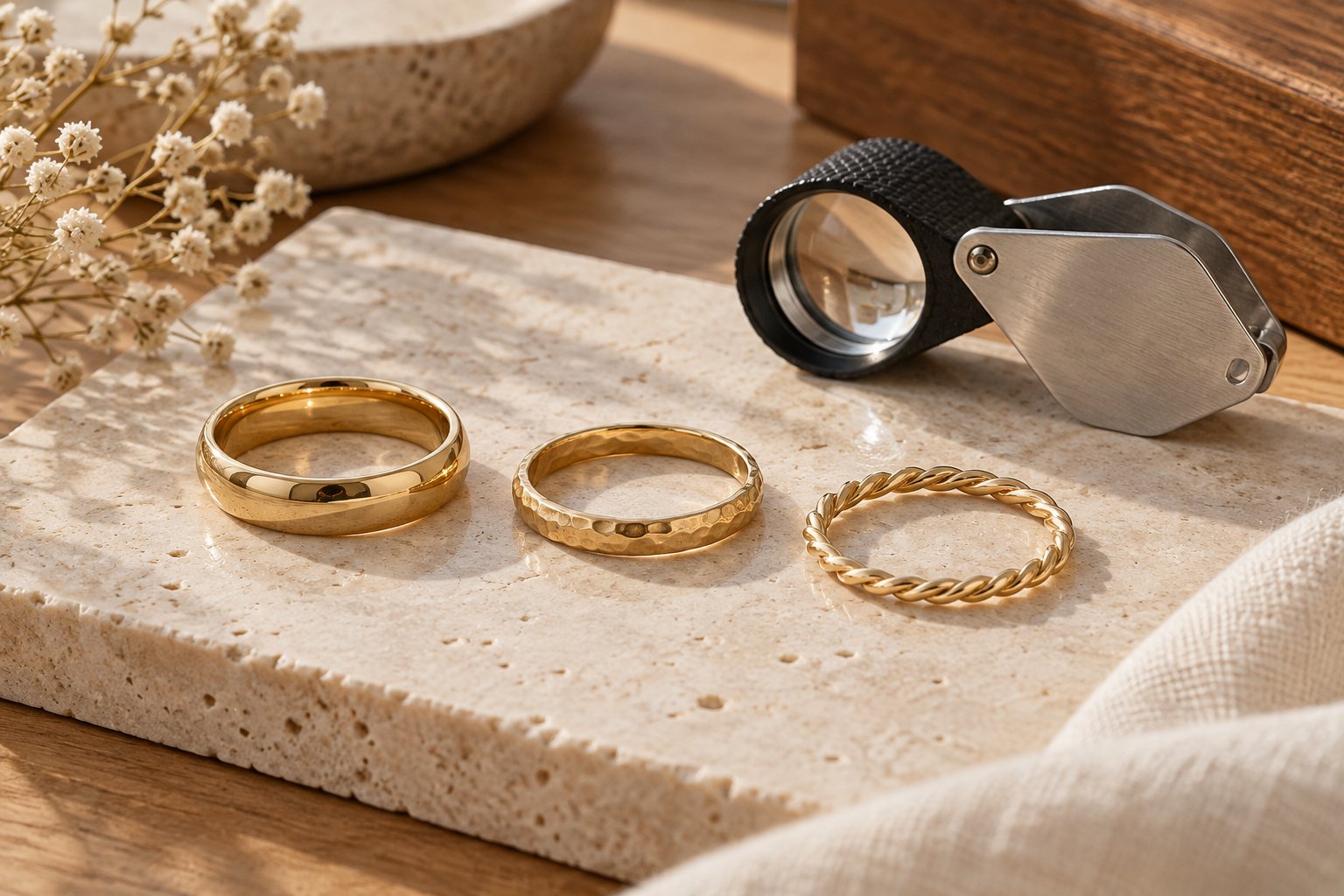
Choose gold-plated jewelry when you want a particular look at a price you can accept for a coated item. Consider gold-filled when you want a mechanically bonded gold layer and a clear material specification. Consider karat-gold jewelry when gold content throughout the metal is a priority. In every case, ask about construction and care before comparing price.
Three pieces can look nearly identical in a photograph while using different materials. Color won't tell you what is beneath the surface. The description needs to do that job.
What the terms describe
- Gold-plated: a gold coating over another material; ask about the base and coating specification.
- Gold-filled: a gold layer mechanically bonded to a base metal; it is not gold throughout.
- Karat gold: an alloy described by its gold proportion, such as 14K or 18K.
- Solid construction: also ask whether a piece is hollow. Material and construction are separate questions.
The FTC's guide to precious-metal jewelry explains these labels, including the use of “solid gold” for an item that isn't hollow. Because shopping descriptions can be ambiguous, request both the composition and the construction in writing.
Gold-plated: buy with the coating in mind
A plated piece has a surface layer that can wear away. How quickly depends on the coating and how the item is used. Avoid treating an unspecified coating as a promise of years of daily wear.
Ask what material is underneath and whether the seller provides a thickness measurement. Also ask whether replating is offered and what that service currently costs. If no repair route exists, include that limitation in your purchase decision.
A pendant you wear occasionally and a ring that meets desks and door handles have different routines. Tell the seller how you plan to use the piece. Broad descriptions such as everyday or premium are less useful than care instructions for the exact product.
Gold-filled: a defined layer, not a solid-gold substitute
The word filled can be misleading if you picture a base-metal shell full of gold. The gold is a bonded outer layer. Under the FTC's jewelry guidance, the gold-filled designation uses a gold-alloy layer of at least 1/20 of the metal weight. The layer's karat is another part of the specification. See the FTC's explanation of its jewelry guides.
Don't read 1/20 as meaning 5% pure gold: the stated layer is itself an alloy. Nor does the term establish a fixed lifetime. Ask whether clasps, posts, and decorative attachments use the same materials as the main piece.
If two sellers use the same label but only one gives a clear specification, you have more information to work with from that seller. Documentation doesn't replace inspection, but vague language makes a comparison much harder.
Karat gold: check more than the number
Karat describes the gold proportion of the alloy. Our 18K versus 21K comparison explains the numbers. Here, the practical question is whether the item uses that alloy throughout its metal parts and whether any components differ.
Ask for the weight and dimensions, then ask whether links or other sections are hollow. A visually large piece may use less metal than you expect. Avoid using an enlarged photograph as evidence of thickness.
Also separate a material description from a durability claim. Fine chains and heavy chains aren't interchangeable purchases. A high gold percentage doesn't make every clasp, joint, or setting equally suitable for your routine.
Compare complete ownership costs
Suppose, purely as an example, you are considering a $40 coated fashion piece and a $240 karat-gold piece. The difference isn't automatically a saving or a waste. It depends on your budget, intended use, repair options, and whether you still want the design after a season. These figures illustrate a decision, not market prices.
For a trend you want to try occasionally, a lower-cost piece may be enough. For a meaningful item you plan to keep, investigate construction and future service more carefully. Don't assume you will recover the retail price by reselling jewelry.
What should you ask before checkout?
Request the metal of each component, any coating specification, dimensions, weight, care instructions, and available repairs. If it is a gift, settle fit and exchange terms too; our online jewelry checklist covers the order details.
For a Saudi shopping reference, RoseGold lists jewelry categories by karat. Check the actual item specification and supported delivery destination directly. We are not suggesting that it sells every material described in this comparison.
Choose the piece whose description and practical limits match what you want to spend and how you will wear it. An appealing label is only the beginning of that decision.
Cover: AI-generated editorial illustration, not a photograph of a specific retailer product.